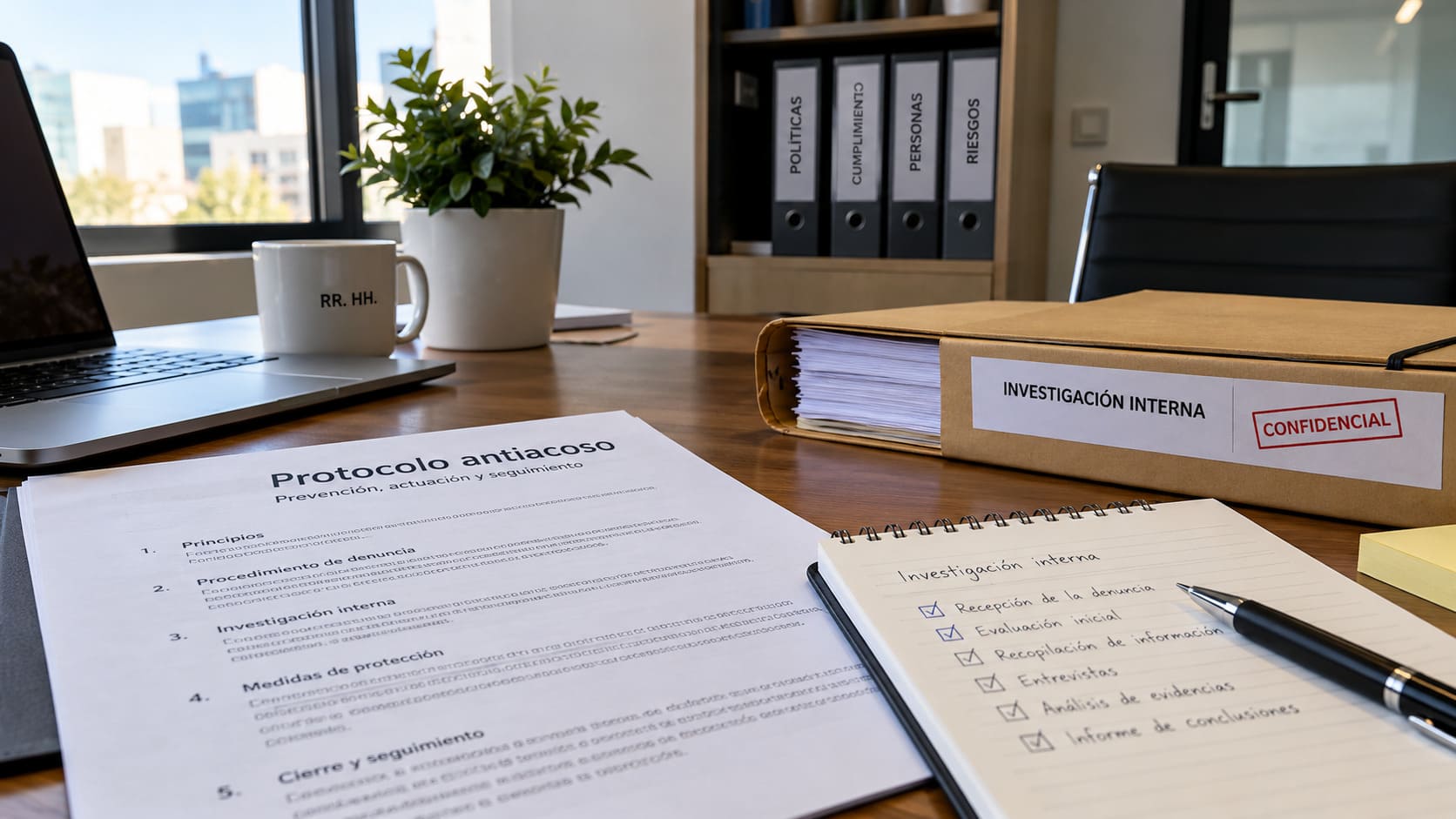
When a company receives a complaint concerning possible workplace harassment, having an internal protocol in place is only the first step.
The real risk arises when that procedure exists on paper but the investigation is not activated promptly, periods of inactivity occur or the deadlines established by the company itself are exceeded without sufficient justification.
A recent judgment of the High Court of Justice of Galicia, Judgment 3073/2026 of 2 July, has again highlighted this issue.
The Court upheld an award of €3,750 in compensation for non-pecuniary damage caused by delays in the handling of a complaint, even though the internal investigation ultimately concluded that there was insufficient evidence to classify the reported conduct as workplace harassment.
The decision is particularly relevant for HR, Compliance and management teams: the outcome of an investigation and the way in which the complaint is handled are separate issues.
How quickly must a company activate an anti-harassment protocol?
There is no single statutory deadline that applies identically to every company and every type of internal protocol.
It is necessary to review:
the applicable legislation;
the relevant collective bargaining agreement, where applicable;
the company’s equality plan;
the anti-harassment protocol itself;
the internal reporting channel used;
and the specific circumstances of the case.
What the courts do require is diligence and prompt action.
Where the company’s own protocol establishes deadlines, those deadlines should not be treated as merely indicative.
In the case considered by the High Court of Justice of Galicia, the internal procedure provided that the complainant should be informed about the status of the complaint within 30 calendar days.
The complaint was submitted on 4 November 2024.
The investigation committee was not formally constituted until 18 December, 44 days later.
According to the established facts, this was the first effective step taken in response to the complaint.
What happened after the investigation was activated?
The initial delay was not the only factor considered by the courts.
The protocol also established a maximum period of three months to complete the investigation, which could be extended in particularly complex cases.
However, once the investigation committee had been constituted, it decided almost immediately to extend the period by a further three months.
The Court found that this extension had not been sufficiently justified in light of the actual progress of the investigation.
Further periods of inactivity also followed.
The company did not obtain external advice until February 2025 and did not attempt to summon the employee to formally confirm her complaint until 6 March, approximately four months after the complaint had first been submitted.
Witness interviews took place at the end of March, and the final conclusions were not communicated until 12 May 2025.
For the Court, the problem was not simply that certain formal deadlines had been exceeded. It was the existence of a prolonged procedure that lacked the urgency expected in an investigation of this nature.
Why is it so important to act quickly after a harassment complaint?
Because employers have a duty to protect the health and safety of their employees, including protection against psychosocial risks.
Spanish occupational health and safety legislation requires employers to guarantee effective protection against work-related risks and to adopt measures aimed at preventing, assessing and addressing them.
The legal framework also requires employers to promote working conditions that prevent conduct contrary to personal dignity and, in particular, sexual harassment and harassment based on sex.
When a complaint is received, the employer’s obligation is therefore not simply to open a file at some point.
There must be a sufficiently prompt response to investigate the facts, assess whether interim protective measures are necessary and prevent a possible risk situation from continuing or worsening.
The Galicia judgment specifically identifies urgency as a fundamental element of an anti-harassment procedure.
What if the investigation ultimately concludes that there was no harassment?
This is one of the most important aspects of the decision.
The investigation in this case was ultimately closed because the committee considered that the evidence was insufficient to classify the reported conduct as workplace harassment.
However, that conclusion did not eliminate the consequences of the earlier delay.
A company may ultimately determine that the reported conduct did not amount to harassment and still have handled the complaint improperly.
These are two different questions.
The duty to act diligently arises when the company receives a complaint that requires investigation, not only when harassment is later proven.
Waiting for the final outcome before deciding whether the matter required prompt action would undermine the preventive purpose of the protocol itself.
Can a delay result in compensation for non-pecuniary damage?
Yes.
In the case considered, the Labour Court had awarded the employee an additional €3,750 in damages.
The company challenged this part of the judgment, but the High Court of Justice of Galicia upheld the compensation.
The Court considered that failure to process the anti-harassment procedure with sufficient urgency could cause independent non-pecuniary harm.
This means that the harm does not depend exclusively on whether the alleged harassment is ultimately established.
Uncertainty, unnecessary prolongation of the procedure and the lack of a sufficiently diligent response from the employer may themselves be legally relevant.
What if the complainant is on medical leave?
Medical leave does not automatically remove the company’s obligation to deal with the complaint diligently.
In the case examined, the employee was temporarily unable to work during part of the relevant period.
The company argued, among other matters, that this circumstance affected the existence of the alleged harm.
The Court rejected that argument.
An employee may still suffer harm as a result of uncertainty and delay in an internal investigation even while temporarily absent from the workplace.
Accordingly, medical leave should not be used as a reason to suspend or unjustifiably delay an anti-harassment investigation.
A different issue is whether individual investigative steps need to be adapted to the employee’s health circumstances.
Can the company justify a delay because the case is complex?
In some circumstances, complexity may justify extending the deadlines established by the protocol.
However, there must be a genuine and sufficiently documented reason.
It is not enough simply to state that the investigation is complex.
Relevant factors may include:
the number of people involved;
the number of witnesses;
the volume of documentation to be reviewed;
difficulties in carrying out particular investigative steps;
the involvement of different offices or countries;
or any other objective circumstance that genuinely requires additional time.
Most importantly, an extended deadline should not become an excuse for inactivity.
Even where more time is justified, the company should continue progressing the investigation without unnecessary interruptions.
Does a lack of experience among investigators justify the delay?
The judgment is also relevant on this point.
During the proceedings, it became apparent that some of the individuals initially responsible for the investigation lacked specific experience or expertise in handling this type of procedure.
The company eventually sought external advice.
The Court accepted that this circumstance might be understandable, but held that it did not justify a lack of diligence on the part of the employer.
If the people appointed under the protocol do not have the knowledge or resources required to conduct the investigation properly, the company must react by providing appropriate support or replacing them.
From a preventive perspective, this raises an important question before the first complaint is ever received:
Are the people designated under the company’s protocol actually prepared to apply it?
Simply including names or job titles in a policy is not enough.
What risks does a company face if it mishandles a harassment complaint?
The consequences can extend far beyond poor internal management.
Depending on the circumstances, an inadequate investigation may result in:
Compensation liability.
As the 2026 judgment demonstrates, an unjustified delay may result in compensation for non-pecuniary damage.
Compensated termination of employment.
In the case considered, the Labour Court also ordered the termination of the employment relationship due to the employer’s breach, with compensation equivalent to that applicable to unfair dismissal. That issue was not the specific subject of the appeal regarding the additional €3,750 award, but it formed part of the overall dispute.
Potential infringement of fundamental rights.
A seriously negligent response may affect rights such as the employee’s moral integrity.
Occupational health and safety risks.
Employers have specific duties relating to the protection of employee health and safety, including psychosocial risks.
Loss of confidence in the internal procedure.
The judgment also highlights a broader organisational issue: if employees believe complaints are not handled diligently, this may undermine confidence in the effectiveness of the company’s reporting and investigation system.
Is having a published anti-harassment protocol enough?
No.
This is perhaps the most important message for employers.
A company may have a well-drafted protocol, have communicated it to staff and even have a dedicated reporting channel.
But if, when a complaint is received, the procedure does not operate effectively in practice, the document itself will not protect the company.
Indeed, setting internal deadlines and then repeatedly failing to meet them without sufficient justification may become evidence of a lack of diligence.
The protocol must therefore be an operational procedure, not merely a formal compliance document.
How should a company respond when a complaint is received?
The specific response will always depend on the facts, but from a preventive perspective the company should have a functioning system prepared in advance.
Once a report is received, it should immediately identify which procedure applies and what deadlines must be observed.
It should also determine who will conduct the investigation and whether those individuals have sufficient independence, training and resources.
Where appropriate, interim or protective measures should be considered in order to protect those involved while the facts are being investigated, without prejudging the final outcome.
The investigation should be properly documented, confidentiality should be maintained, the parties concerned should be given an opportunity to be heard and unjustified periods of inactivity should be avoided.
If the protocol allows deadlines to be extended, the company should record why the extension is necessary.
Once the investigative steps have been completed, the corresponding conclusions and decisions should be adopted and communicated as promptly as possible.
Documenting the company’s response also matters
In subsequent litigation, it may not be enough for the company to state that HR was working internally on the matter.
The company should be able to prove what steps were actually taken.
The date on which the complaint was received, communications with the complainant, constitution of the investigation committee, interviews, requests for documents, interim measures, justification for extensions and the final conclusions should all be properly documented.
In the case considered by the Galicia Court, the company argued that certain internal meetings had taken place during the first few weeks.
However, there was no evidence that those meetings had resulted in concrete action in relation to the complaint.
From an evidential perspective, the traceability of the investigation may be just as important as the internal work itself.
An anti-harassment protocol must work when it is actually needed
Judgment 3073/2026 of the High Court of Justice of Galicia provides an important reminder for employers.
The company’s responsibility does not end with having a protocol and a reporting channel in place.
Once a complaint is received, the employer must be able to show that the system operates effectively, diligently and with sufficient speed.
The eventual closure of the investigation does not automatically remedy poor handling of the process.
An investigation may conclude that harassment did not occur and the company may still have caused harm by allowing a procedure that should have been dealt with promptly to remain unresolved for months.
Companies should therefore review not only whether they have an anti-harassment policy, but also whether its deadlines are realistic, the people responsible are properly trained and the organisation has mechanisms in place to react immediately when a complaint is received.
At Solium Legal, we advise companies on employment and compliance matters, including the review and implementation of internal protocols, workplace investigations and the prevention of risks arising from employment disputes.