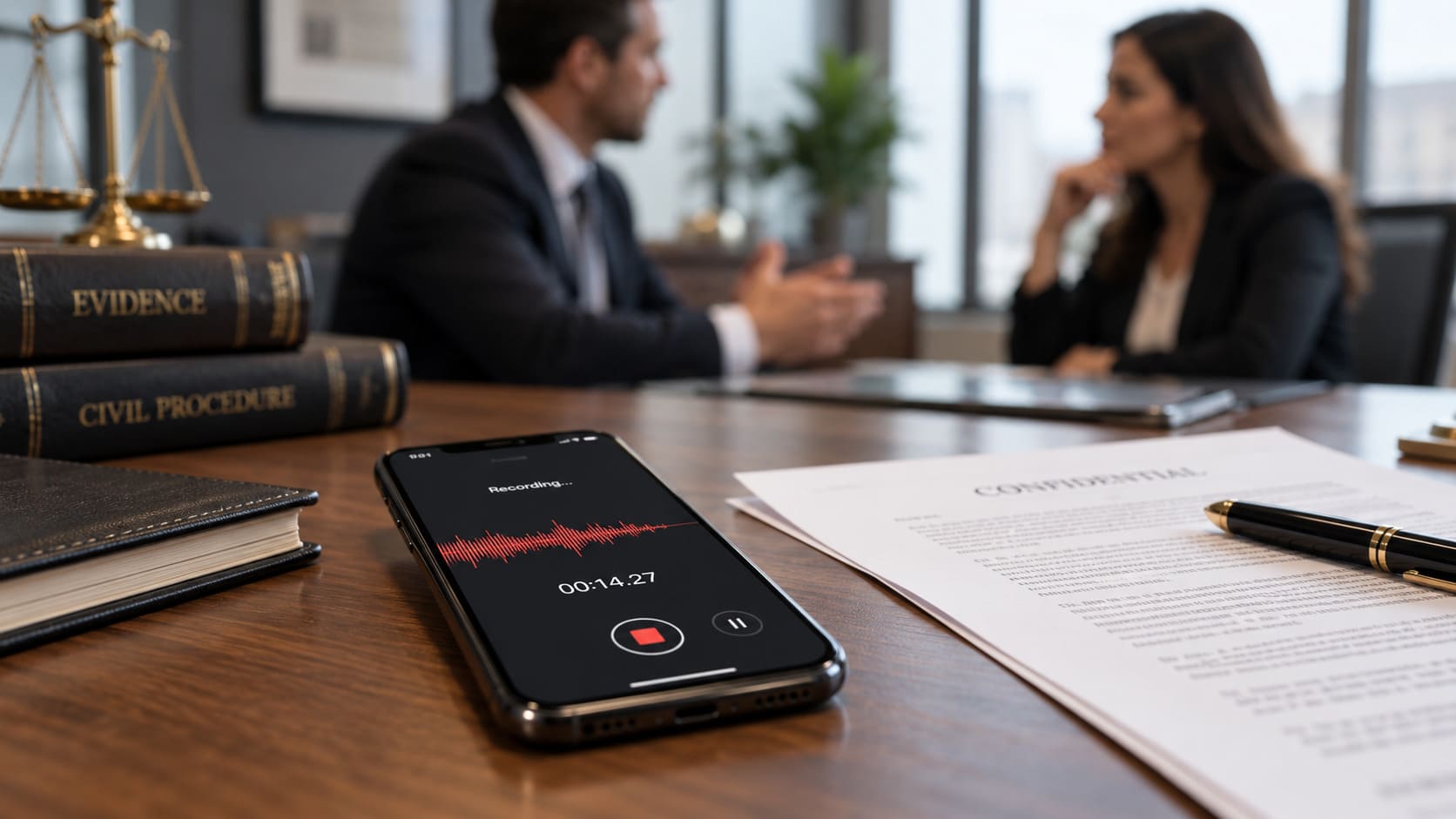
A conversation may contain an admission, a threat, acknowledgement of a debt, instructions given in the workplace or any other statement that could be relevant to proving certain facts.
For this reason, when a dispute arises, a common question is: can I record a conversation without telling the other person and later use it as evidence in court?
The answer depends fundamentally on one issue: who makes the recording.
Recording a conversation in which you are personally participating is not the same as placing a device or using another means to record a private conversation held exclusively between other people.
This distinction is essential both when assessing whether the recording was lawfully obtained and when determining whether it can subsequently be submitted as evidence in judicial proceedings.
A recent Spanish Supreme Court judgment, Judgment 521/2026 of 28 July, has brought this issue back into focus by examining the covert recording of a private family conversation by a person who was not taking part in it.
Is it legal to record a conversation without telling the other person?
If the person making the recording is one of the participants in the conversation, recording it without first informing the other participant does not, by itself, breach the constitutional right to secrecy of communications.
Spanish case law has maintained this distinction for decades.
The secrecy of communications protects individuals against third parties intercepting communications to which they are not a party. However, someone who directly participates in a conversation already has legitimate access to what the other person is communicating to them.
From the perspective of Article 18.3 of the Spanish Constitution, there is therefore an essential distinction between:
recording a conversation in which you participate,
and
recording a conversation between other people.
This does not mean, however, that every recording made by one of the participants is automatically lawful in every circumstance or may subsequently be used without restriction.
Other rights may also come into play, particularly the right to privacy, as well as the specific circumstances in which the recording was obtained and later used.
Can I use a conversation I recorded myself as evidence in court?
As a general rule, a recording made by one of the participants in the conversation may be submitted as evidence, even if the other participant did not know that the conversation was being recorded.
Spanish procedural law expressly recognises recordings of words, sound and images as possible forms of evidence.
However, the fact that a recording can be submitted does not mean that it will necessarily be admitted or that the court must give it full evidential value.
Among other matters, the court may need to consider:
- how the recording was obtained;
- whether the person recording was actually part of the conversation;
- whether the conversation involved particularly private matters;
- whether the recording is relevant to the dispute;
- whether the file is authentic and complete;
- and whether there are any indications that it has been edited, manipulated or taken out of context.
Two separate questions should therefore be distinguished:
Was the recording lawfully obtained?
and
Is the recording sufficient to prove a fact before the court?
The answers will not necessarily be the same.
Recording your own conversation is not the same as secretly recording other people
This is probably the most important distinction.
Suppose two people are having a conversation and one of them activates the voice recorder on their phone without telling the other.
Even though the other person has not consented, the person making the recording is part of the conversation and is the direct recipient of what is being said.
The situation changes completely when someone records a conversation between third parties in which they are not participating.
In that case, the person is no longer simply preserving something they are directly hearing as a participant. Instead, they are covertly gaining access to another person’s private communication.
Depending on the circumstances, this conduct may breach fundamental rights and may even amount to the criminal offence of discovery and disclosure of secrets under Article 197 of the Spanish Criminal Code.
What did the Spanish Supreme Court decide in 2026?
Supreme Court Judgment 521/2026 of 28 July is particularly relevant because it examined a recording made by someone who was not participating in the conversation.
The facts arose in a family context.
A woman covertly recorded a private conversation between her then husband and his parents. She was not taking part in the conversation and made the recording without the consent of those involved.
She later used the audio recording in judicial proceedings relating to allegations of gender-based violence in an attempt to support certain facts she had reported.
The covert recording ultimately resulted in criminal proceedings being brought against the person who made it.
The Supreme Court upheld her conviction for the offence of discovery and disclosure of secrets.
The judgment is particularly significant because it makes clear that an intention to use a recording as evidence in future legal proceedings does not make the manner in which it was obtained lawful.
In other words, trying to obtain evidence for use before a court does not, by itself, authorise someone to intercept the private conversations of other people.
Does the conversation have to contain particularly intimate information?
The 2026 judgment also provides an important clarification on this point.
The defence argued that the recorded conversation did not contain information that was sufficiently private or confidential to justify applying the criminal offence of discovery and disclosure of secrets.
The Supreme Court rejected that approach.
Where a third party covertly intercepts a private conversation with the purpose of discovering secrets or interfering with the privacy of those involved, it is not necessary for the recording to ultimately reveal extremely sensitive information.
The conversation does not need to disclose medical, sexual, financial or otherwise particularly compromising information.
What matters is the unlawful intrusion into a private conversation and the purpose pursued through the recording.
The fact that the people being recorded ultimately discussed apparently ordinary matters would therefore not automatically make the covert interception lawful.
Can recording someone else’s conversation be a criminal offence?
Yes.
Article 197.1 of the Spanish Criminal Code criminalises certain conduct carried out without consent and with the purpose of discovering secrets or violating another person’s privacy.
It expressly covers the use of technical devices for listening, transmitting, recording or reproducing sound.
A person who installs a device, leaves a phone recording or uses another method to covertly obtain access to a private conversation between other people may therefore face criminal liability.
Once again, this must be distinguished from a situation in which the person pressing the record button is actually participating in the conversation.
Can I record a telephone conversation in which I am participating?
The same basic principle applies.
The fact that the conversation takes place in person, by telephone or through another form of communication does not, in itself, alter the fundamental distinction.
If someone participates in a telephone call and records what the other person is saying to them, the mere fact that they do so without warning does not, by itself, amount to a breach of the secrecy of communications.
A very different situation would involve intercepting or recording a telephone call between two other people without being one of the participants.
Can I record a conversation with my employer or an employee?
Recordings are also frequently used in employment disputes to try to prove instructions, comments, threats, harassment, arguments or circumstances surrounding dismissal.
Where the employee or employer making the recording is directly participating in the conversation, the recording does not, for that reason alone, breach the constitutional right to secrecy of communications.
However, this does not mean that every recording will be sufficient to determine the outcome of an employment dispute.
The court will still need to consider issues such as the authenticity of the audio, the identity of the participants, when the conversation took place, whether the file is complete, the context in which statements were made and their relevance to the facts being disputed.
The legality of making a recording and its evidential weight are two separate questions.
Can I record a conversation with my partner or former partner?
Again, the key distinction is whether the person recording is participating in the conversation or intercepting communications between other people.
The existence of a current or former personal relationship does not remove the rights to privacy and secrecy of communications.
A person may generally record a conversation in which they themselves participate, subject to the particular circumstances of the case.
However, this does not give them freedom to leave hidden recording devices in order to capture conversations between their partner or former partner and relatives, friends or other third parties.
It is also important to distinguish between recording a conversation and disclosing it.
Even where someone has lawfully obtained a recording, this does not necessarily mean that they may publish it, forward it to others or disclose its contents without restriction.
Recording and disclosing a conversation are different issues
This distinction is particularly important.
A person may be entitled to record a conversation in which they participate and yet subsequently incur liability if they unlawfully distribute or disclose its content.
Keeping an audio file in order to establish facts before a lawyer, public authority or court is not the same as publishing it on social media, sharing it in a messaging group or distributing it indiscriminately to third parties.
Where the recording contains private information or affects the privacy of those involved, its subsequent use must be assessed separately.
The question “Can I record this conversation?” is therefore not necessarily equivalent to “Can I do whatever I want with the recording afterwards?”
What requirements should a recording meet in order to be used as evidence?
When an audio recording is submitted in court proceedings, one of the most common issues is proving its authenticity and integrity.
The opposing party may deny that the voice is theirs, claim that the audio has been edited, challenge the date on which the conversation took place or argue that certain parts have been removed.
In these circumstances, preserving the original file properly can be particularly important.
Useful precautions may include:
- keeping the complete audio rather than only an extract;
- avoiding unnecessary editing, trimming or conversion of the file;
- retaining the original device where possible;
- preserving metadata and other information associated with the file;
- clearly identifying the participants;
- documenting the date and circumstances of the conversation;
- and considering expert technical analysis if authenticity is disputed.
A written transcript may make the recording easier to review, but a transcript does not replace the original audio file.
Is expert analysis of the recording always required?
Not necessarily.
Spanish courts do not require every audio recording to be accompanied automatically by an expert report before it can be considered.
Authenticity may be demonstrated by different means, depending on the circumstances of the proceedings.
However, where one of the parties denies taking part in the conversation, challenges the voices or alleges manipulation, technical expert evidence may become particularly relevant.
This issue has become increasingly important given the ease with which modern technology can be used to edit recordings, imitate voices or generate artificial audio.
Preserving the original file and the information that helps establish its origin is therefore becoming increasingly important.
Can a recording be rejected even if it was legally obtained?
Yes.
A recording being lawfully obtained does not automatically make it useful or decisive in judicial proceedings.
A court may consider that it is insufficiently connected to the dispute, that it does not prove what the party submitting it claims it proves or that doubts remain about its authenticity.
A recording may also capture only one part of a longer conversation and, when heard in isolation, give an incomplete impression of what happened.
Courts assess evidence as a whole and in conjunction with the other material available in the proceedings.
What if the conversation was deliberately arranged to obtain a confession?
This issue requires particular caution, especially in criminal proceedings.
Spontaneously recording a conversation is not necessarily equivalent to deliberately arranging an encounter or using specific tactics solely to obtain a confession that can later be used against another person.
The Spanish Supreme Court has recognised in different cases that the specific circumstances in which a recording is obtained may affect both its admissibility and its evidential value.
Problems may arise in particular where deception is specifically used to induce a self-incriminating statement or where the person provoking the conversation is acting from a position of public authority.
There is therefore no general rule that every recording is automatically admissible simply because the person making it was one of the participants.
Can the police record conversations without consent?
This involves a different legal framework.
Where law enforcement authorities seek to intercept or record certain private communications as part of a criminal investigation, the specific safeguards established by Spanish criminal procedure apply and, in the circumstances provided by law, judicial authorisation may be required.
The rules applicable to a private individual recording a conversation in which they participate should not automatically be extended to investigative measures undertaken by public authorities.
Interception of communications is particularly sensitive from a constitutional perspective and is subject to its own legal safeguards.
Can an illegally obtained recording be used as evidence?
The unlawful acquisition of a recording can seriously affect its use in court.
Spanish law establishes that evidence obtained, directly or indirectly, through the violation of fundamental rights or freedoms cannot produce legal effect.
Where someone who is not part of a conversation covertly intercepts communications between other people, this may constitute a breach of the secrecy of communications and, depending on the circumstances, may also amount to criminal conduct.
Before submitting a recording of questionable origin, it is therefore essential to analyse how it was obtained.
The fact that its contents might be highly useful in establishing certain facts does not automatically make the method by which it was obtained lawful.
What if the recording proves that a criminal offence was committed?
The fact that information may be relevant to discovering or proving an offence does not mean that any method of obtaining it is justified.
Supreme Court Judgment 521/2026 provides a particularly useful example.
The person convicted had obtained the recording with the intention of using it in other judicial proceedings to support her own allegations.
Even so, the Supreme Court confirmed that covert interception of another person’s private conversation could constitute the offence under Article 197 of the Criminal Code.
An evidential purpose therefore does not amount to a general authorisation to intrude into the private communications of third parties.
Where someone believes that a criminal offence is being committed, legal mechanisms exist to report the matter and allow the competent authorities to obtain evidence through the procedures established by law.
Who can bring a complaint if several people were secretly recorded?
The Supreme Court’s July 2026 judgment also provides guidance on this issue.
Where a third party intercepts a private conversation between several people, each of the participants may be affected by the intrusion.
It is not necessary for the recording later to be used against all of them.
In the case considered by the Court, the recording had mainly been used in proceedings connected with one of the participants, but the Supreme Court held that the privacy of the other participants had also been affected.
The protection therefore relates to the private conversation itself and not only to the person against whom its content is subsequently used.
What should be considered before submitting a recording in court?
Before using an audio recording in legal proceedings, it is advisable to consider not only what it contains but also how it was obtained and how it has been preserved.
Where the recording may be particularly important to the case, it is useful to verify:
- who made the recording;
- whether that person was participating in the conversation;
- where and in what circumstances the conversation took place;
- whether there was a particularly strong expectation of privacy;
- whether the file has been preserved in full;
- whether it has been modified in any way;
- whether the participants can be identified;
- how the recording relates to the facts being disputed;
- and whether its use could affect any fundamental rights.
Unnecessary disclosure of the audio should also be avoided.
The fact that a recording may be useful as evidence does not make its contents freely distributable.
The key question is not only whether there was consent, but who was recording
The expression “recording without consent” can be misleading if the surrounding circumstances are not examined.
Not every recording made without informing the other participants has the same legal status.
Where the person making the recording is participating in the conversation, the lack of consent from the other participant does not, by itself, make the recording unlawful or necessarily prevent it from being submitted as evidence.
Where the person making the recording is a third party who is not participating in the conversation, the position changes substantially.
Covert interception of a private communication may breach the secrecy of communications and, where the legal requirements are met, may even constitute the criminal offence of discovery and disclosure of secrets.
The recent Supreme Court Judgment 521/2026 of 28 July reinforces precisely this distinction: the intention to obtain evidence for subsequent use before a court does not justify the covert interception of private conversations between other people.
Before making or submitting a recording, it is therefore essential to consider who participated in the conversation, how the recording was obtained, what it contains and the purpose for which it is intended to be used.
At Solium Legal, we advise individuals and businesses in judicial proceedings and on matters relating to the obtaining, submission and assessment of evidence, as well as issues involving privacy rights, secrecy of communications and criminal liability.